
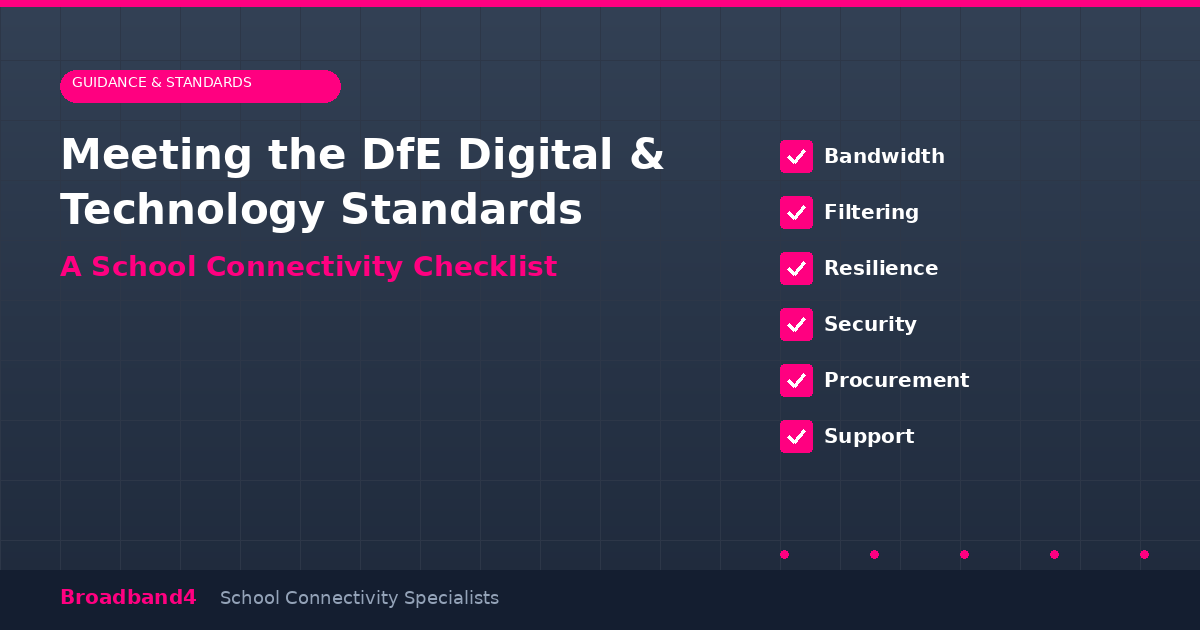
Meeting the DfE Digital and Technology Standards: A School Connectivity Checklist
The DfE digital technology standards set clear expectations for how schools should plan, procure and manage their technology infrastructure — and school connectivity sits right at the heart of them. For many school leaders, the standards represent a welcome shift from vague guidance to practical, measurable benchmarks, but translating them into action can feel overwhelming, particularly when budgets are tight and technical expertise within the school is limited.
Without a reliable, well-managed internet connection, almost every other technology investment — from cloud-based MIS platforms and interactive displays to safeguarding tools and VoIP telephone systems — underperforms or fails entirely. A school can have the best devices and the most carefully chosen software, but if the underlying connection is unreliable, slow or poorly managed, the investment is wasted.
This article breaks the connectivity-related DfE digital technology standards into a practical school connectivity checklist, explains what good looks like for each area, and highlights the questions you should be asking your current or prospective provider. If you are looking for a provider who specialises in education, Broadband4 can help.
What Are the DfE Digital Technology Standards?
Published as part of the DfE’s broader strategy to improve technology across education, the digital and technology standards cover everything from device procurement and cybersecurity to network design and internet connectivity. They apply to all state-funded schools in England and are increasingly referenced by Ofsted during inspections.
The standards are not legislation, but they carry significant weight. Schools that align with them demonstrate due diligence in safeguarding, data protection and value for money — three areas that governors and inspectors scrutinise closely. Conversely, schools that fall short may find it difficult to justify their technology decisions when challenged.
For school business managers and headteachers, the standards provide a useful framework for evaluating existing provision and making the case for investment where it is needed.
Why School Connectivity Matters More Than Ever
A decade ago, the internet was a useful tool in schools. Today, it is essential infrastructure. Registers, timetabling, parental communications, safeguarding logs, lesson delivery, assessment platforms and even telephone systems now depend on a live internet connection. The shift to cloud-based services has been dramatic: most schools now have very few locally hosted systems remaining.
When connectivity fails, the impact is immediate and far-reaching:
- Safeguarding systems go offline, leaving staff unable to log or escalate concerns. Platforms like CPOMS and MyConcern become completely inaccessible.
- Teaching stops in classrooms reliant on cloud-based resources, interactive whiteboards and online assessment tools. Lesson plans built around digital content cannot be delivered.
- Administrative functions halt, from attendance recording and parental notifications to finance systems and HR platforms.
- VoIP telephone systems fail, cutting the school off from parents, local authorities and emergency services.
The DfE digital technology standards recognise this reality and set expectations for school connectivity accordingly. Schools are expected to treat connectivity as critical infrastructure, not a convenience.
Your School Connectivity Checklist
1. Bandwidth: Is Your Connection Fast Enough?
The DfE recommends that schools have sufficient bandwidth to support all users and devices simultaneously, without degradation. In practice, this means:
- A minimum of 100 Mbps for small primary schools with fewer than 200 pupils
- 500 Mbps to 1 Gbps for larger primaries and all secondary schools
- Dedicated, uncontended bandwidth wherever possible
Contended connections — where bandwidth is shared with other users outside the school — can appear adequate on paper but slow to a crawl during peak hours. A 1 Gbps connection with a 50:1 contention ratio might deliver as little as 20 Mbps when it matters most. This is particularly problematic during morning registration, when hundreds of devices connect simultaneously, and during periods when multiple classes are streaming video content or taking online assessments.
What to ask your provider: What is the contention ratio? Is this a dedicated or shared circuit? What guaranteed minimum speed will you commit to in writing?
2. Filtering and Monitoring: KCSIE Compliance for School Connectivity
Keeping Children Safe in Education (KCSIE) requires schools to have appropriate filtering and monitoring systems in place. The DfE digital technology standards go further, specifying that filtering should:
- Block harmful and inappropriate content across all devices and users on the school network
- Be age-appropriate and granular enough to distinguish between year groups, staff and visitors
- Not rely solely on keyword blocking, which produces excessive false positives and frustrates teachers
- Include monitoring that flags concerning patterns of behaviour for review by trained safeguarding staff
Many schools still rely on basic filtering that either over-blocks (preventing legitimate educational use) or under-blocks (allowing harmful content through). The IWF (Internet Watch Foundation) standards provide a useful benchmark for filtering effectiveness, and your provider should be able to confirm IWF list integration. Broadband4 provides Smoothwall filtering which meets both KCSIE and IWF requirements.
What to ask your provider: Does your filtering solution meet IWF standards? Can it differentiate between staff, sixth-form and primary-age pupils? How are filtering reports generated and who reviews them? Does filtering apply to backup connections as well as the primary circuit?
3. Resilience: What Happens When Your Connection Fails?
The DfE standards expect schools to have considered resilience — the ability to maintain connectivity during an outage. For most schools, this means having a backup internet connection that activates automatically if the primary circuit fails.
A backup connection should:
- Use a different technology to the primary circuit (for example, 4G/5G cellular if the primary is fibre)
- Activate automatically without requiring staff intervention
- Provide sufficient bandwidth to maintain critical functions including safeguarding, registers and communications
- Route traffic through the same filtering and monitoring systems as the primary connection
Schools without backup connectivity are a single point of failure. A severed fibre cable, an exchange fault or a provider outage can take a school offline for hours or even days. The cost of a managed backup is typically between £50 and £150 per month — a fraction of the operational cost of even a half-day outage. Read more about backup connectivity for schools.
What to ask your provider: Do you offer automatic failover? What technology does the backup use? How quickly does failover activate? What bandwidth does the backup provide? Is filtering maintained on the backup circuit?
4. Network Security: Is Your Infrastructure Protected?
Connectivity standards overlap with cybersecurity expectations. The DfE expects schools to take a proactive approach to network security, recognising that schools are increasingly targeted by cyber criminals. Schools should ensure:
- The network has a properly configured, managed firewall that is regularly updated
- DNS-level filtering is in place to block known malicious domains before they reach the network
- The network is segmented so that a compromise in one area (such as a guest Wi-Fi network) does not affect critical systems
- Regular vulnerability assessments are conducted, ideally by an independent party
What to ask your provider: Is a managed firewall included in the service? Do you provide DNS-level protection? How is the network segmented and who manages it? What happens if a security threat is detected?
5. Procurement and Value for Money
The DfE standards encourage schools to avoid long-term contracts that lock them into underperforming services. Schools should benchmark their connectivity costs against comparable institutions and ensure they are comparing like-for-like: contended versus dedicated, download-only versus symmetric, managed versus unmanaged.
Key considerations include avoiding contracts longer than 36 months unless there is a clear financial benefit, ensuring you are not paying for services you do not use, and looking for providers who specialise in education and understand the specific requirements of schools. An education-specialist provider will typically offer better value than a generic business ISP because they design their services around the needs of schools from the outset.
What to ask your provider: What is the total cost of ownership including installation, equipment and support? What happens at the end of the contract? Can I scale bandwidth up or down during the term?
6. Support and Service Management
When connectivity fails during the school day, every minute matters. The DfE digital technology standards expect schools to have access to responsive, knowledgeable support. This means UK-based support teams who understand the education sector, proactive monitoring that identifies issues before they cause outages, and clear SLAs with defined response and resolution times.
A good provider will detect problems before you do. Proactive monitoring means your provider is watching the health of your connection in real time and taking action — or at least alerting you — before a fault becomes a full outage.
What to ask your provider: Where is your support team based? What are your response time commitments? Do you proactively monitor our connection? Will you alert us to issues before we notice them?
How Broadband4 Helps Schools Meet DfE Digital Technology Standards
Broadband4 specialises exclusively in school connectivity. Every service we provide is designed around the specific requirements of the education sector, from KCSIE-compliant Smoothwall filtering to automatic 4G/5G failover connectivity.
Our approach aligns directly with the DfE digital technology standards for school connectivity: dedicated, uncontended internet access with guaranteed bandwidth; Smoothwall filtering and monitoring that meets IWF and KCSIE requirements; automatic backup connectivity for business continuity; proactive monitoring with UK-based, education-specialist support; and flexible contracts with transparent pricing and no hidden costs.
We work with schools across England, from small village primaries to large secondary academies, and we understand that every school’s needs are different. That is why every engagement starts with a free connectivity review. Find out more about our managed internet services or direct internet access.
Next Steps
If you would like to discuss any of the points raised in this article, or if you are reviewing your school’s connectivity provision against the DfE digital technology standards, our team is here to help. We offer a free, no-obligation connectivity review that assesses your current setup against current standards and identifies any areas for improvement.
Get in touch at broadband4.co.uk/contact or call 01425 880081 to arrange your free review.
Related Posts
Why Every School Needs a Backup Internet Connection (And How to Choose One)
Every school needs a reliable backup internet connection to keep teaching, safeguarding and communications running…
Leave a Reply